An AI code editor for your own models and keys
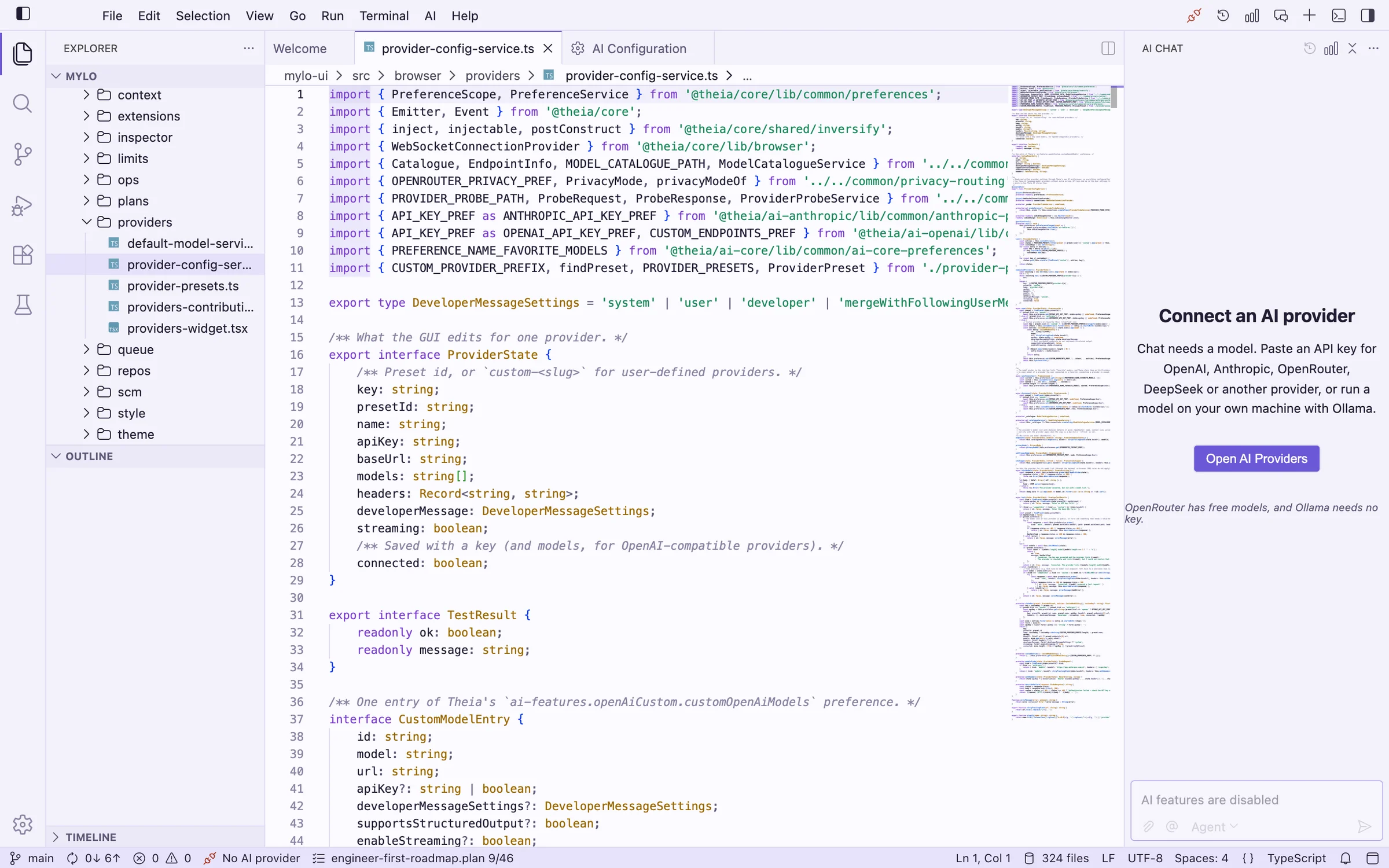
MyLo is a free, open-source editor built on Eclipse Theia. Connect your own API key or a local model, and chats and agents work on your code. No account and no subscription.
macOS, Apple silicon · Open source · No account
Features
What MyLo can do today.
Many chats, three modes
Open as many chats as you like, each with its own model. Ask answers questions, Plan writes a checklist for you to approve, and Agent edits files and runs commands, asking first. Messages you type while it works wait in a queue.
Bring your own key
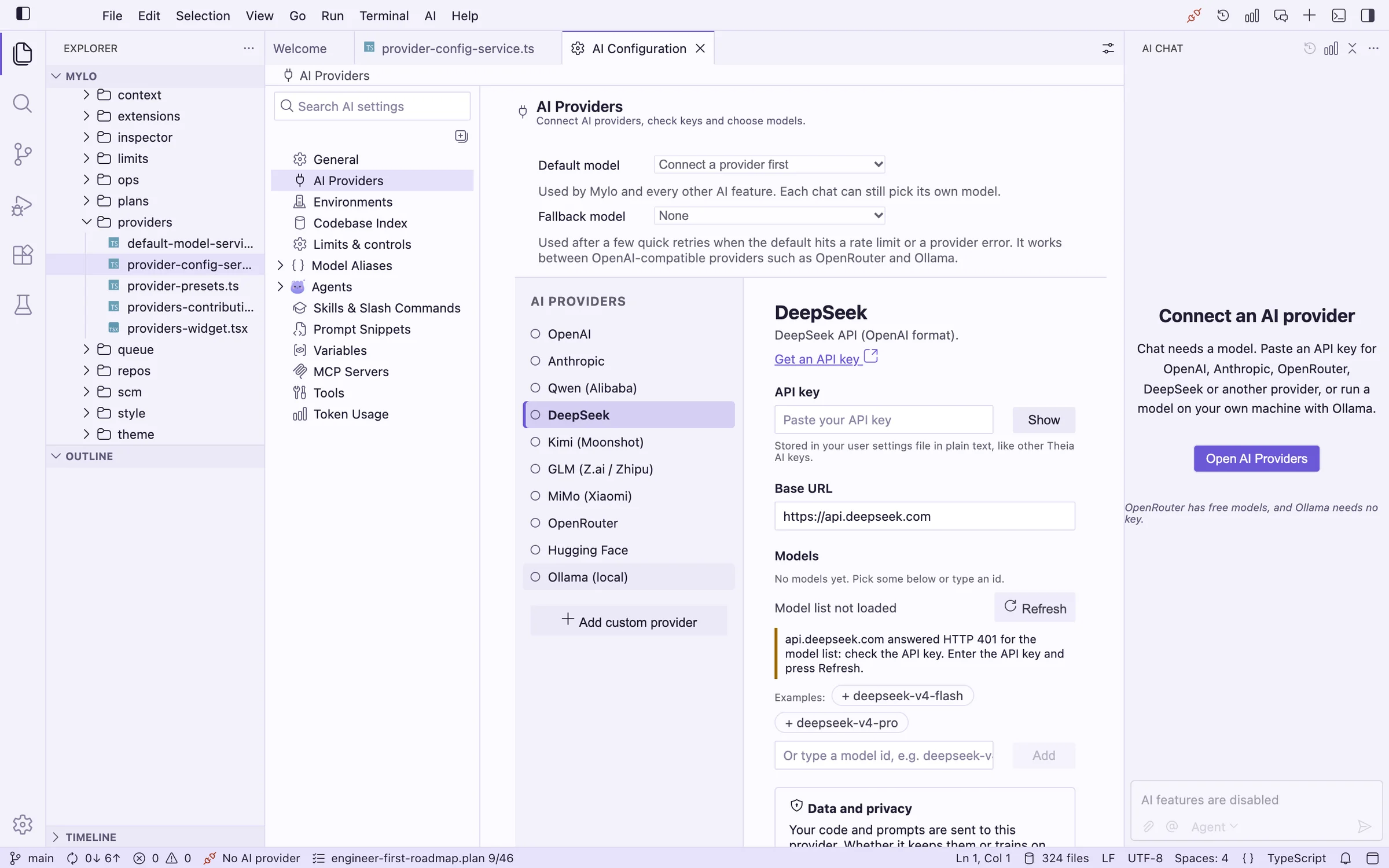
OpenAI, Anthropic, Qwen, DeepSeek, Kimi, GLM, MiMo, OpenRouter, Hugging Face, or anything that speaks the OpenAI format. You pay the provider directly.
Plans that survive
Plans are checklists saved in your project. Agent mode ticks steps off, /resume carries on after a stop or a restart, and long runs compact themselves before the context fills up.
See what it did
The Agent Inspector lists every model call and tool call with its tokens and time, and keeps them across restarts. Token Usage keeps an estimated cost, and a ring next to Send shows how full the context is.
Reads the web
Chats can search the web and read pages as Markdown, using Brave, Tavily, your own SearXNG or DuckDuckGo with no key. Local and private addresses are blocked.
Several repositories
Open more than one folder and pin each chat to a repository. Search and reads start there and reach the others by name. Every folder is indexed on your machine.
Servers, with approvals
Describe servers and Docker engines in .mylo/environments.json. The agent can read logs and run commands over your own ssh, and anything that changes something asks first, with the host named. Dangerous commands are refused, and nothing stores a password.
Searches your code
Your open folder is indexed on your machine. Chats can search it and read files, so answers are about your code.
A real editor
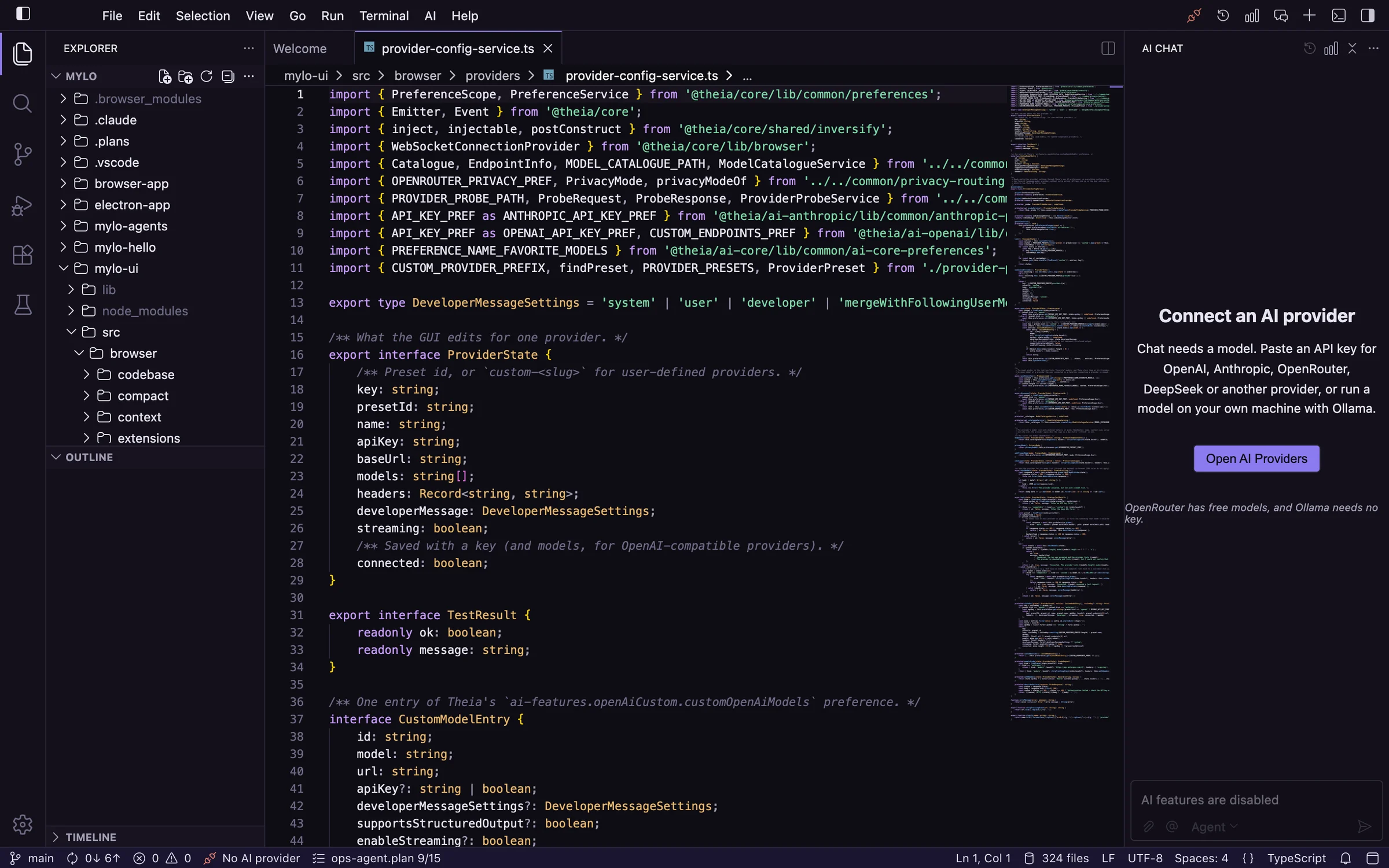
Monaco (the editor in VS Code), a terminal, search and source control, as a Mac app or in a browser tab.
Previews
Markdown with math and Mermaid diagrams, plus images, audio and video, open right in the editor.
VS Code extensions
Install extensions from Open VSX. Git comes from the VS Code git extension.
Light and dark
MyLo Light and MyLo Dark follow your system and switch live when it changes.
Local by default
No account to create. The keyword index never leaves your machine, and indexes live in app data, never in your project. Semantic search is off unless you turn it on. API keys are kept in your user settings file, in plain text.
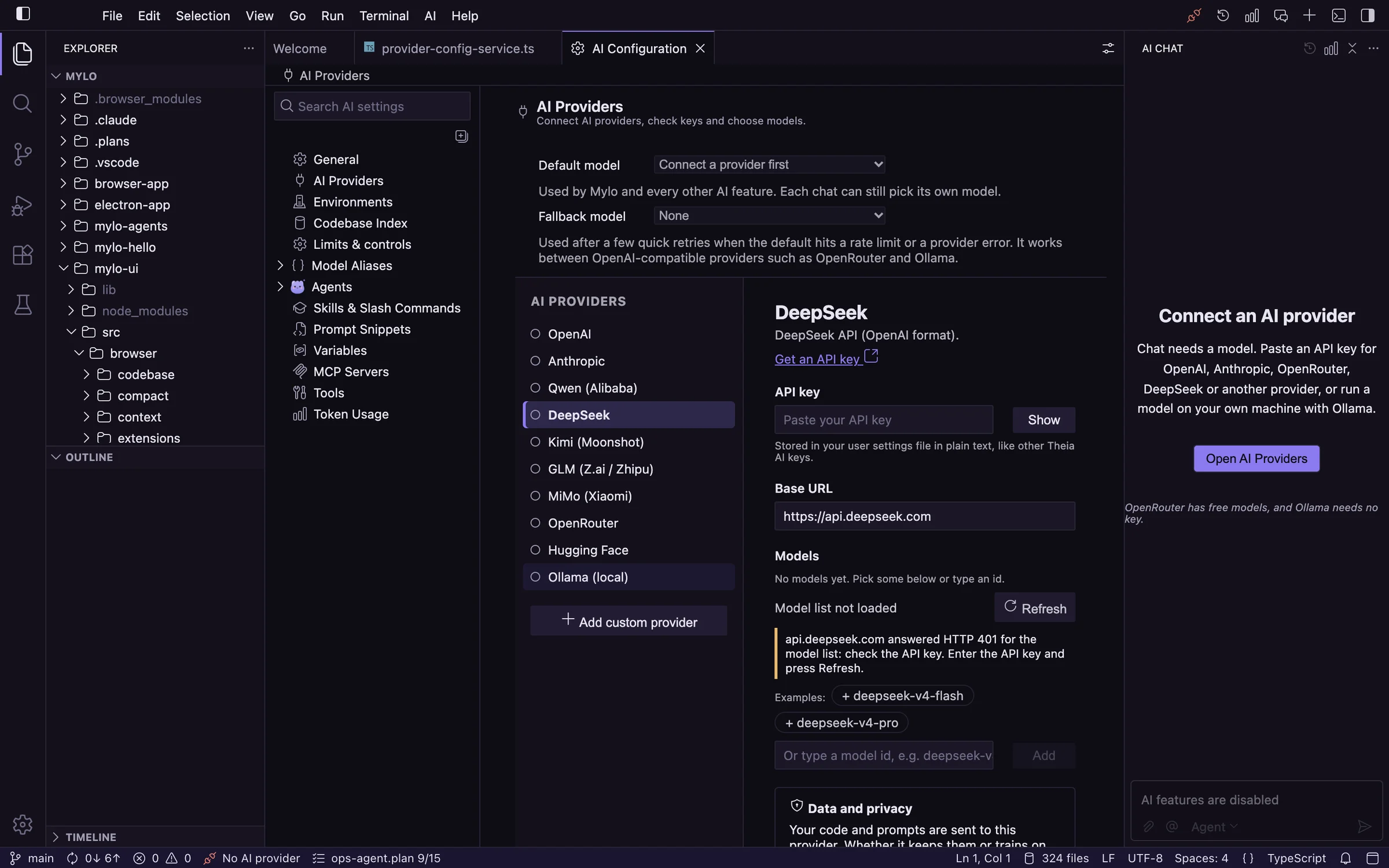
Connect any provider from one screen
Paste a key, test it, pick models. Anything OpenAI-compatible can be added as a custom provider.
Ollama needs no key. It is checked against a stand-in server that speaks its API, not a real Ollama install yet.
What has been tested
How far each area has been checked. "In use" means used regularly on real projects.
| Area | Status | Notes |
|---|---|---|
| Editor, terminal, search and source control | In use | Source control uses the VS Code git extension. |
| Chat, agents, plans, queued messages and compaction | In use | Used with GLM, DeepSeek and Kimi through OpenRouter. |
| Agent Inspector, token usage and estimated cost | In use | History is kept across restarts. |
| Local code search | In use | Chats use it to find and read files. |
| Markdown, Mermaid, media previews and Open VSX extensions | In use | Go, rust-analyzer and icon themes have been installed. |
| OpenRouter | In use | Key test, model list and chat. |
| OpenAI, Anthropic, Qwen, DeepSeek, Kimi, GLM and MiMo | Not verified | Presets come from public documentation. Any model id can be typed. |
| Hugging Face and Ollama | Simulated only | Tested against stand-in servers. |
| Semantic search | Simulated only | Tested against a local test server, not a real embeddings provider. |
| SSH and Docker environments | Simulated only | Tested with a stand-in ssh. Every change asks first. |
| Several repositories in one workspace | New | Tried with small repositories. |
| Folders on external drives | Not verified | A fix is in place but has not been confirmed on a real drive. |
More than 570 automated tests cover the logic. The app itself is checked by hand.
Known limitations
- Edits are applied directly once you approve them; there is no diff review step yet. Use git to review and undo.
- Additional chat windows start empty after a reload.
- There are no Linux or Windows builds.
- Some interface labels still mention Theia.
Get MyLo
A disk image for Apple silicon Macs, or build it yourself.
MyLo for macOS
Requires macOS on Apple silicon. The app is not signed, so the first launch needs one confirmation.
- Download the
.dmgand open it. - Drag MyLo onto the Applications folder.
- Open it. The first time, right-click the app and choose Open, because it is not signed.
Build from source
git clone <repository-url>
cd mylo
yarn
yarn build:browser
yarn start:browserThen open http://127.0.0.1:3100. Use that address rather than localhost. To build the Mac app instead, see the docs.
Fixed
- 0.5.0 was packaged with an old copy of the app code, so it came without most of what its notes describe (live clocks, the Activity view, previews, Live Server, screenshots, the right-hand strip, the agent's job tools). This version has all of it. Packaging now stops when the app bundle is older than the code.
- Opening a font, archive or other binary file no longer brings up "The file is either binary or uses an unsupported text encoding. Open anyway?" (it kept coming back when an agent worked with such files); a short note says the file was not opened as text.
- The clock on a tool row now shows even when the tool's call id could not be matched, and the row's Stop button still finds its command.
Added
- A running shell command shows a Stop button on its own row in the chat, next to its live clock. It ends that command only; the agent is told it was stopped and carries on.